Saturday, August 9, 2014

Planners and Productivity 101

My friend S complained on Facebook yesterday about the irony of getting nothing done because she spent all day yesterday researching ways to be more productive. That, S, has happened to most of us. {shameful look} You are not alone!

I find three things actually help me to be more productive: a morning routine, planning in advance, and having production goals instead of time goals.

Notice that none of these things are about the "usual" productivity tricks, like having a schedule, doing two things at once, or making the perfect tasks list.

I have those things in my toolbox, of course. I have a rough schedule of the day on my weekly (or occasionally daily) pages and a set schedule of mandatory appointments on my monthly planner pages. I often multitask. For example, I stand up and clean the kitchen whenever I am chatting on the phone with my sisters. I wipe down the inside of the car and clean it out while parked in the carpool line. I do have tasks for today, tasks for this week, and tasks for the long term noted. In addition, I make special tasks lists to help me complete a project.

But none of these really make me more productive. For instance, I might multitask chatting on the phone and cleaning, but I can't really do that during a work call. Doing two things at once  is NOT always the best plan. (Texting on a cell phone while driving? BAD IDEA.) And if I spend my whole day making schedules and tasks lists, I get nothing important accomplished.

Instead, I start with a regular morning routine. It's my signal to my mind to get into work mood. It doesn't take long - less than 15 minutes - but it gets my day moving and is a smooth transition between nonwork and work.

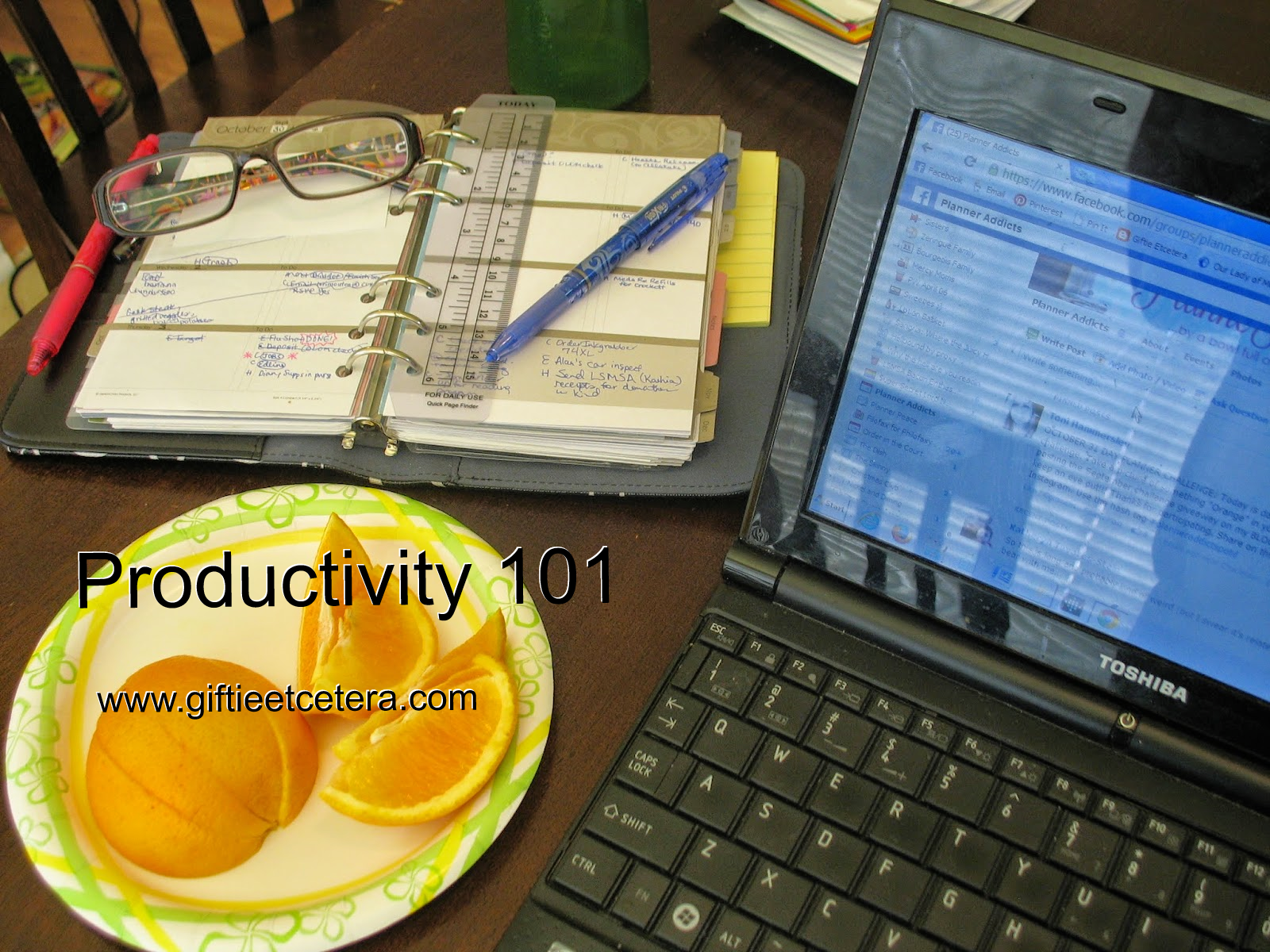
For me, my morning routine is putting on my glasses, having a cup of coffee (and sometimes breakfast), checking my messages/e-mail, and looking at today's planner pages. It can be done anywhere where I might work - at home, at the office, or at a coffee shop.


Productivity Time management getting things done


I know a lot of productivity experts talk about waiting to check e-mail. That is such a sweeping statement that does not take into account the nature of your work and your temperament. For me, I need to know if any urgent e-mails need to be dealt with first thing in the morning. I'm also not a person who gets lost in e-mail.

The point here is to create a morning routine that says "ready to work" to you. Maybe you are a school teacher, and that routine means taking roll, checking your mailbox, or tea in the teacher's lounge until the bell. Perhaps you need to write a daily list to get started. Maybe you visit with your co-workers for five minutes, then shut your office door. If you are a stay-at-home mom, maybe it means tucking the youngest in for a nap and finally brushing your teeth (you know, at 2 p.m., when you finally have a minute to yourself). Whatever it is, make it simple, quick, and consistent. And give it time! It will take some practice, putting the routine together with subsequent work, for your brain to make that important connection.

I also plan in advance. Otherwise, dealing with obstacles will sidetrack your routine.

Some ways that I plan in advance include writing appointments and due dates in my planner as they pop up, instead of trying to remember all of them. I dress appropriately for the day. I put out meat to defrost for dinner or prep double veggies the day before. I make sure I have the tools to do my job with me (packed in a tote bag the night before if I am working away from my home office).

Finally, and this one is the key to success for me, I make production goals instead of time goals.

Maybe my goal is to chop fruit for the week for lunches, research and write the portion of my work project that deals with Alabama and New York, or finish all the letters/bills that need to go in the mail this month.

What I try to never use as a goal is a time-based one, like "working 5 hours" or "getting errands done by 4 p.m." I know, I know. All the productivity experts disagree with this. They say to make and follow a schedule. Workout for 30 minutes or work on Smith project for 3 hours. But I NEVER do it. I would just watch the clock the whole time, and I would be miserable.

Instead, with a production goal, like run two miles or make a complete outline for the Smith project and write the first three paragraphs, I am concentrating on getting things accomplished. I feel a sense of success that does not come from working for 3 hours. My brain learns to crave that high.

Oh, and happy side result? I tend to make my billable hours goals or have free time left to do something else (like read a book or watch a movie).

TIP: If you have a production goal and limited time, set a timer to know when you HAVE to stop, goal accomplished or not. No need to clock watch and stress yourself out.

Etcetera.


Thursday, August 7, 2014

Daily Planner Pages - An Update

Today was the first day of school for my kids, complete with an hour and a half carpool. I had my home office phone line hooked up. I worked (for my real job) for five hours. I put away laundry, made and served breakfast and dinner, heated up lunches, and dusted the table and cabinets. I made my weekly menu and grocery list. (I promise a menu planning post is coming soon. Keep me honest on my Facebook group, Giftie Etcetera.) I oversaw cccchhhhhhhoooooorrrrrreeeesssss (dragged out to approximate Loki's whining about doing chores after having to go to ssssscccccchhhhhhhhooooolllll). (First grade is going to be special, y'all.)

It was a busy, stressful day.

Tomorrow is more of the same. Carpool, five hours of scheduled legal work, errands to bank, produce stand, and grocery store, and lots of little tasks. I also need to remember about karate lessons, even though my husband will do the driving.

I already blogged about using daily pages or a daily docket on busy days, separate from your usual weekly entries. Today, I wanted to show you that supplemental daily page in action.

First, I write over the weekly entry "SEE SUPP" (for supplement) in my highlight color. All of the weekly entries will be copied onto the daily page, along with any new stuff.


Second, I plan out my upcoming day on the daily page. I just keep several copies printed out (from a quick template in Word) and hole-punched in my planner. This supplemental page goes right in between this week's weekly pages.


The details...

*I circle the day of the week and write the date on top of the page. At first, this step felt like wasted time. But I realized that I use my planner as a calendar more than I thought. I also would be looking at the wrong page sometimes, if I didn't write the day of the week.

*I basically have three columns (though the page is only divided into two parts). Timed events and FYI times (both in the first large box) and tasks.

*In the timed events column, I write in start and end times.

*In the FYI times column, I write things like where I'll be (if it varies from my usual routine) or times when other family members have activities.

*In the tasks column, I schedule tasks.

Tasks go in that order so that I accomplish my tasks throughout the day. Some tasks are time-specific, like prepping for dinner.

On a regular day, I can keep track of when tasks should get done in my mind. But with so many tasks and timed events, I need my daily page on a busy day.

*Any unscheduled tasks (rarely, but it happens) or notes go on the back of the page.

*I still use my context codes (like E for errand) and a circle to indicate a task. I use an * to refer me to another page in my planner, like my daily chores sticker.

I don't love daily pages, but for now, they are working one or two days per week.

Seriously, though, only do this if you have an appointment driven life or an extremely busy day. It's not worth the trouble otherwise.

Etcetera.

Sunday, August 3, 2014

Sweeps,15s, and EEs: Maintaining A Clean, Organized Living Space

***This post may contain affiliate links. These links help you find the items that I use in my planner and financially support this blog. See my "Disclaimer" link for additional details.***

I dream of a clean house. Even before I owned a house, my offices, classrooms (when I taught school), and dorm rooms were a struggle to keep organized. Don't let the fact that I write a blog about organizing fool you. My house is NOT company ready. However, by adopting some daily habits, my house CAN be company ready in about 15 minutes.

I use three techniques to keep the house from getting overwhelming. They can be adapted to work for an office or dorm room, too. The techniques are daily sweeps, 15 minute quick cleans, and erasing the evidence.

My planner has a sticker with a daily checklist.


Sweeps and the 15 minute quick clean are parts of the checklist. If everything on the list is complete, I circle the day. (If I am not planning to do my normal routine, say because I'll be gone all day or out of town, I mark those days with an X.) Unmarked days are meant to shame me into being more diligent!


Sweeps are done in the morning (along with planning/prepping food for dinner and getting laundry in the wash). However, if I work outside of the home on a particular day, they get done as soon as I get home from work. To sweep, I simply go from room to room in the house and put away anything not in its home. I just move in a circle.

For example, in my bedroom, I might have a couple of pieces of clothing that need to be put away, the shoes that I was wearing when I went to bed, and a hair clip next to my bed. In the bathroom, my husband might have left migraine medicine on the counter during the night. In the kitchen, I might have a bag of groceries to unload or a pan cooled down from the night before to put away. The living room might have remote controls hanging around away from their homes.


At first, you might have so much stuff out of place that you have to limit your sweeps. In fact, if my house gets really messy, I limit the number of items that I put away in each room to 5. Eventually, though, I get to the point that sweeps only require me to put away a couple of things in total each day.

15 quick cleans generally take place at suppertime, but always before bed. I spend 15 minutes cleaning, starting with the areas that have the most need or make the most impact (often the kitchen and living room). If I have any time remaining, I move to the bathroom or bedrooms. Sometimes, I do the cleaning while preparing supper. The order of priority is determined by 1) the area with the most need, 2) the area that will make the most impact on our lives, and 3) anything that has been bothering me.

If you have children who are old enough, have them do a sweep of their rooms and bathrooms in the morning (or right after school) and a 15 minute chore time, as well. It's not a lot of time, but it makes a big difference.

Finally, erase the evidence of whatever you do throughout the day. I used to say "clean up after yourself" to the kids, but they never really quite got everything put away. Instead, we pretend the house is filled with spies, and we have to put things back so that it looks as if we didn't move anything in the first place.

Consider brushing your teeth in the morning. You could brush and put the toothbrush and toothpaste away. But what happens to the little bits of toothpaste that drop into the sink? What about the towel you used to dry your hands after rinsing? Erasing the evidence means you also rinse the sink and rehang the towel, plus let Mommy know to put more toothpaste on the list if you are almost out. We practice this by inspecting each other's work.

This system is not perfect. I have to forgive myself all the time for missing a day or two or not completely erasing the evidence. But it really does, without much effort, make life easier and our home more orderly.

Join the conversation about cleaning, organizing, and planning at Giftie Etcetera's Facebook group today.

Etcetera.

Saturday, August 2, 2014

Don't Be The Family Planner

So much of the advice I read on-line about planning for multiple people (mostly, I mean the other people in your household) does not translate well to reality. 

In particular, a lot of people recommend that, in addition to your own planner, you keep a family calendar so everyone can know what is planned.

Bullocks, I say. (That's very British of me, but I am not British, so I just hope I used it correctly. I've been teaching my kids British swear words instead of American ones, in the hopes that when they repeat "oh, bloody hell," the principal doesn't call me at home. But if he does, I am totally blaming my husband! Shhh...don't tell.) 


Having a family calendar just means that YOU spend extra time maintaining it while everyone else virtually ignores its existence...and just asks you when things are happening anyway. (And, really, isn't that a good reason for a swear word?)

TIP: Instead of a family calendar, have a recipe book holder set up in a central location. When not using your planner, leave it open to the monthly calendar on the recipe book stand.

A better solution than a family calendar, in my opinion, is that everyone keeps their own calendars and respects each others' systems.

This is not an easy solution, of course, but it pays dividends. Seriously, it's much easier to just track everything for everybody, on the front end. Bu
that doesn't teach your children to plan carefully, define your spouse as an equal partner, or have the long-term benefit of actually forcing your family to actively decide how to spend valuable time. 

By keeping his/her own calendar, each person is forced to be more thoughtful about the day. 


Now, as Plannerds, we need to realize that not everyone will use a planner. My 5 year old's version of scheduling is asking, "do we have school tomorrow or not?" My 8 year old knows, in his head, that karate is on Tuesday and Thursday. My husband only keeps a calendar at work, on Outlook, and peeks into my planner all the time. The thing is that all of them are doing ACTIVE thinking about schedules, instead of a passive approach of just having the schedule written for them.

Sure, I write down their stuff as they communicate it, for my reference.

But that's the key - someone has to communicate it. As soon as they are initiating communication, they are taking responsibility for themselves and opening up the possibility of discussing hurdles or conflicts between their plans and your plans. Instead of chasing them down and asking how they are getting to soccer practice, you are discussing the problem of getting to soccer practice.


TIP: Have a clear rule that NOBODY writes in your planner but you. All sorts of trouble can result otherwise. 


At the same time, let them leave you notes to remind you to add things to your planner. My husband sends those as Facebook messages. My 8 year old writes "by moor eyes cream" on a notepad on my desk. Sometimes, you just don't have time to discuss things. A note, at least, starts communication.

(My expectations are low for the 5 year old. Mostly, his stuff just goes in my planner. Just to show you why, the (sideways, sorry) picture below was taken at an ACTUAL school for gifted children. He is pushing the door when he should be pulling. Remind you of any famous cartoons?)


TIP: When you communicate to your household, do so in the way that they understand and naturally respond to rather than your favorite method of communication. 


For example, my husband does well when sent an e-mail or Facebook message, since he plans on Outlook during the work day. (Also, when he says that I "didn't tell" him, I can pull out the evidence. Blast!) A teenager might do better with a text message. My littler kids need reminders the night before and physical reminders, like the karate bag sitting in the doorway when they are about to leave the house.

TIP: As soon as your kid can read and write fluently (around 3rd or 4th grade, usually), pick out a planner with him/her. Do a daily review and a weekly review together. Let the child decorate it. Planing is a skill that will benefit a kid throughout his/her lifetime.


If you decide to go this route, and make each person responsible for their own plan, please realize that there will be mistakes. 

Someone will miss baseball practice. Your husband will book a business dinner the same night as the Bangles concert. (What, you've never been to a Bangles concert?!?) It's okay. You'll have to communicate and make decisions at that point. Then, your family will learn to think of others when booking things.

Here's the thing - the SAME MISTAKES would have happened if you were the only one writing things done. Except, and this is important, YOU would have gotten blamed.

And...

Your kid wouldn't have learned to plan ahead of time, to put his karate uniform by the door, and to write things down.

Your spouse wouldn't have learned to add events to his calendar and to check with you first before booking an important business meeting.

You would have been stressed out, overwhelmed, and felt guilty.

Avoiding all that is worth the sacrifice of a central family calendar.

I know today's post ignores most professional organizer wisdom. But my goal here is to make life better for you and your loved ones, not to repeat the advice of others. (Not that I am opposed to repeating good advice, mind you.)

A family calendar is the easy way out, but it doesn't teach, doesn't completely respect the one maintaining it, and is so often ignored. Avoid all that, and give your family the tools to plan and communicate, instead of a useless wall of square boxes.

I'd love to hear from you about this radical idea in the comments. Or, even better, come discuss planning, organizing, and ordering your life at the Giftie Etcetera Facebook page.

Etcetera.

Thursday, July 31, 2014

Help...My Planner Is Broken

Okay, maybe it's not MY planner that is broken, exactly. Of course, there have been weeks when my planner just wasn't working for me. And I often hear confessions from my fellow Plannerds.

"I haven't touched my planner in a week." -You Know Who You Are

"My planner isn't working. I need to go spiral." -Random Friend

"My planner isn't working. I need to go [bigger, smaller, ring bound, etc.]" -Same Random Friend

If your planner literally breaks, you can replace it. But if it's broken in a metaphorical sense, fixing it can eliminate stress, ensure success, and change your day-to-day life. To fix it, you just need to find the source of the problem.


*Planner Not Big Enough

PROBLEM: Sometimes, your planner just doesn't have enough space.

SOLUTION: It is not shameful to add a section, add sticky notes, or add a bigger planner to your collection. Just be careful that you really do need the space. For example, I don't have regular clients right now as a corporate lawyer. But when I was a criminal defense attorney, I saw clients all day long. Just to write down appointments, I needed a bigger planner. Upgrade if you must, but be realistic and choose the smallest size planner that will work for you.

*Planner Not Small Enough


PROBLEM: A major hurdle for a lot of people is that their planners are too bulky or heavy to carry.

SOLUTION: Consider a smaller planner, but be mindful of the sections. I've streamlined my tabs to dashboard, projects, calendar, future, and files. If you can do that, you might get away with a smaller planner.

*Planner Needs Have Changed

PROBLEM: Even if you don't need a different size planner, when you graduate, have a baby, or make any major life changes, you might need to rethink your needs.

SOLUTION: Start a list (in your planner) of what is working and what is not working. Add things that you wish your planner handled better. Using that list, rework your planner set-up.

For example, when I entered law school, my life revolved around deadlines. Before that, as a teacher, dates were much more important. Tuesday - turn in lesson plans. Friday - meet with principal. But as a law student, we had a massive reading list every day. After a while, it became clear that I needed a homework page instead of just tracking on my calendar. Now, as a lawyer, my much less frequent due dates are written on my calendar again.

Join the conversation about planner problems and beyond - focusing on getting your life in order - at Giftie Etcetera on Facebook. We can help you with solutions. Give us your wish list and we'll give you ideas!

*Planner Is Someone Else's Style

PROBLEM: Sometimes, Plannerds get so involved in Facebook groups and blogs that they end up copying ideas that don't really fit the individuals. (Yes, I just told you to join my Facebook group. Yes, I understand the irony.)

SOLUTION: If it is not working for you, get rid of it, even if the idea is brilliant. (Find some of my most brilliant ideas here. Only use the ones that work for YOU, though.)

*Carrying Case Is Too Small/Uncomfortable

PROBLEM: Sometimes, your briefcase, purse, or tote bag is just too small for your planner, even though your planner is the smallest you can get away with.

SOLUTION: Stop buying tiny bags. Stop buying huge bags where everything gets lost. Stop buying bags with uncomfortable straps.

I have a convertible backpack (the purple/pink one pictured in the sidebar), a work tote (with a nice padded strap), and a more formal purse. All of them fit my planner. Usually, my planner lives in the purse. The only exception that I make is the "little black dress" exception. If I am wearing the equivalent of a little black dress, I leave my planner in the car and carry a tiny purse. (Actually, I'm more likely to just hand my husband my phone and I.D. for his pockets! He HATES that. :) ) If I get a second purse (say, in a different color), it also fits my planner. Guys, if you are the planner sort, you are probably the man bag sort, so this goes for you, too.

*Planner Has No Home(s)

PROBLEM: If you don't know where your planner is, you won't use it.

SOLUTION: Have a dedicated home for your planner. In my house, that means the table next to the couch, my desk, or in my purse. That's it. Three places to look. I never lose it.

TIP: Buy a nice recipe book holder for home and work. Open your planner to today's date and leave it there. You'll never lose it again.

*Planner Has Lost Her Focus

PROBLEM: In this case, YOU are the planner. It happens to everyone. You use your planner every day, like clockwork, and then, suddenly, you don't. At first, you get by. You manage to remember about the dentist. You get a present for the birthday party. But, one day, something slips through the cracks. You did not remember about the doctor and now you owe a "missed appointment fee." You don't turn in a project at work. Things start to spiral out of control.

SOLUTION: This solution is a little more complicated, but it's the most important. So pay attention.

1. Brain dump - Put everything that you remember on a piece of paper in your planner.

2. Resolve - Promise yourself that, from this moment on, you will write everything in your planner. And do so.

3. Daily Alarm - Set an alarm, twice a day, to look in your planner. When the alarm goes off, read what is on your calendar and task list.

Repeat these three steps daily until you are back on track.

Etcetera.

Wednesday, July 30, 2014

Planner Page Perfection

One of the reasons that I rarely plan electronically is because I can't control the page enough in something like Outlook or a shared Google calendar. So I search endlessly, instead, for my favorite paper set-up.

The reality is...you are not going to like this...there is NO PERFECT SET-UP.

Shhh. It's okay. Take a moment and calm yourself.

Because, you see, while there is such a thing as the perfect planner page, the one that serves you and your needs is already very close to perfect.


For me, this week, that meant a combination of a weekly and a daily page. Plus, it meant lots of very visual scratch-outs, so whatever is left to do pops out at me.

Next week, it might mean tracking water consumption or workouts. Perhaps I need to track time spent working or what outfit I need to wear. Maybe I use my planner pages for menu planning.

Planner page perfection just requires a few things:

1. a general set-up that makes YOU visually happy (with color or lack thereof);

2. a layout that makes sense to YOUR brain; and

3. creative uses of your set-up.

Creative uses for your planner pages are the key to going beyond the bland entries in a electronic calendar.

For example, track water right there on the dated entry by writing a small number for each glass that you drink - 1, 2, 3....

Or use my sticker solution for your daily tasks.

Add your menu plan to the top of the page, the bottom of the page, or next to each date.

Give your task entries context codes.

Doodle. It helps cement your thoughts in your brain.

Divide and conquer (something that is virtually impossible to do with an electronic calendar).

Planner page perfection is not about the neatest, cleanest, and most color-coded page out there. It is about a page that works for you AND you working the page.

Happy planning! Join us in the Giftie Etcetera Facebook group to talk about planners (even electronic ones) and everything else to keep your life in order.

Etcetera.